Keeping eight destinations in sync from a single source
How ApexStream adapts one encode per platform—bitrate, audio, and aspect—so Scale-plan multistreams stay in sync without re-encoding on your machine.
How ApexStream adapts one encode per platform—bitrate, audio, and aspect—so Scale-plan multistreams stay in sync without re-encoding on your machine.
When one destination fails mid-stream, ApexStream isolates the fault, keeps the rest live, and runs a controlled reconnect path so one bad handoff doesn't take
From your encoder or Web Studio to every destination: the real path a live frame takes through ApexStream's ingest, mix, and server-side fan-out.
Retention windows and storage caps are not vague cloud promises. Here is exactly how ApexStream holds, ages, and expires your stream recordings by plan.
WHIP and an in-browser mixer closed the gap with traditional encoders. Here's what changed under the hood—and when Web Studio is the right path.
Web Studio hard-blocks Go Live unless RNNoise is actively processing — why we rejected a soft warning and what the gate actually checks.
ApexStream clamps Facebook Live near 4 Mbps on the relay only — so your encoder settings stay yours while that destination stays stable.
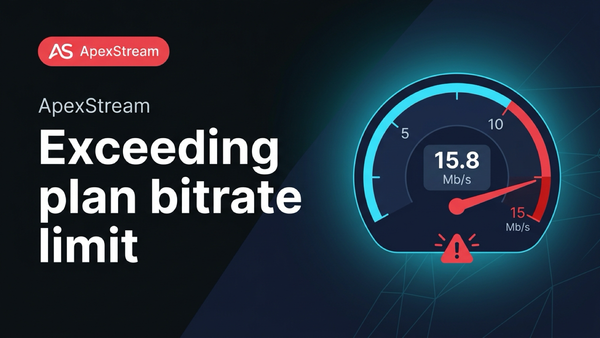
Inside the source-quality enforcer: 6-second probe grace, tier bitrate/resolution caps, and why we kick instead of silently degrading.
Free plan burns an ApexStream drawtext watermark in the relay filter, with capacity math so passthrough stays cheap where it can.
How ApexStream turns one ~6 Mbps upload into 2–50 destinations so home internet stops being the multistream bottleneck.
Studio Sound is Creator+ FFT denoising in the podcast mastering chain — strong on hum and hiss, wrong for some music-heavy shows.
A fault-isolated bridge turns Web Studio recordings into Podcast Studio drafts — encoder captures still need a manual import.